

Insights Be found before you’re judged
Before anyone judges your work, a search engine judges your website. Speed, structure and your Google Business profile decide who gets seen. The page decides what happens next.
Contents
Not found for the right search
Spirit Events is an event-management and audio-visual company in Doha. It was not being found for the searches that bring its clients in.
We saw that discovery was the problem, and that discovery is technical: speed, structured data, the mobile experience and the Google Business profile decide who ranks, long before anyone judges the work.
So we rebuilt the website for search, and connected it to YouTube, social and Google Business so that every channel points to one place.
The rebuild was mobile-first, with a CDN and video performance work. It added structured schema, FAQs and on-page SEO, user-journey tracking and an active blog, and the Google Business profile was optimised to match.
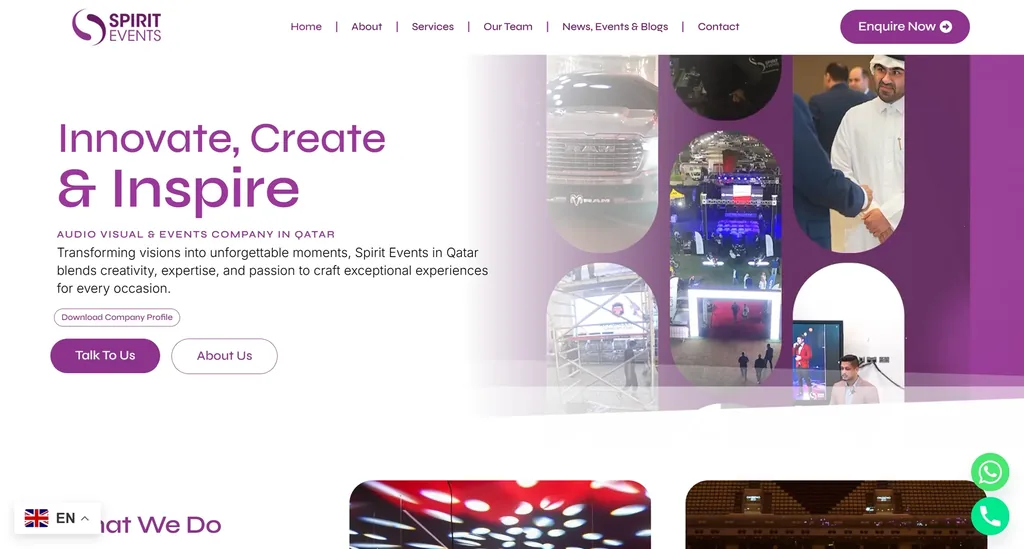
What the company is and where, in its first lines
Enquire Now, in the header
Talk To Us
Download Company Profile
Mobile-first layout
CDN and video performance
Structured schema
FAQs and on-page SEO
User-journey tracking
Drawn from the project record. Not visible on the page.
Diagram, not a capture of Google’s results.
#3
on Google for ‘Event Management Companies in Qatar’, within 7 days
Spirit Events · Fezey-reported
Event Management Companies in Qatar
After the ranking
A ranking is a position for one search on the day it was checked, and it moves. It is also only the first station. It earns a visit, and the page has to do the rest.
That is why the rebuild treated the website as the place every channel points to. Whether someone finds Spirit Events on Google, on YouTube or on social, they land on the same site.
Illustrative.
Google search
Google Business
YouTube
Social
Enquiry
On a phone, that site keeps the next step within reach: call and WhatsApp at the top of the screen and again under the thumb, and every service with its own way in.

Call and WhatsApp, at the top
WhatsApp and call again, under the thumb
Each service with its own way in
User-journey tracking is the part that tells you whether a ranking is paying. It shows which pages people arrive on and which of them lead to an enquiry, so the next round of content is written for the searches that bring clients.
Related reading Websites · Spirit Events case study
